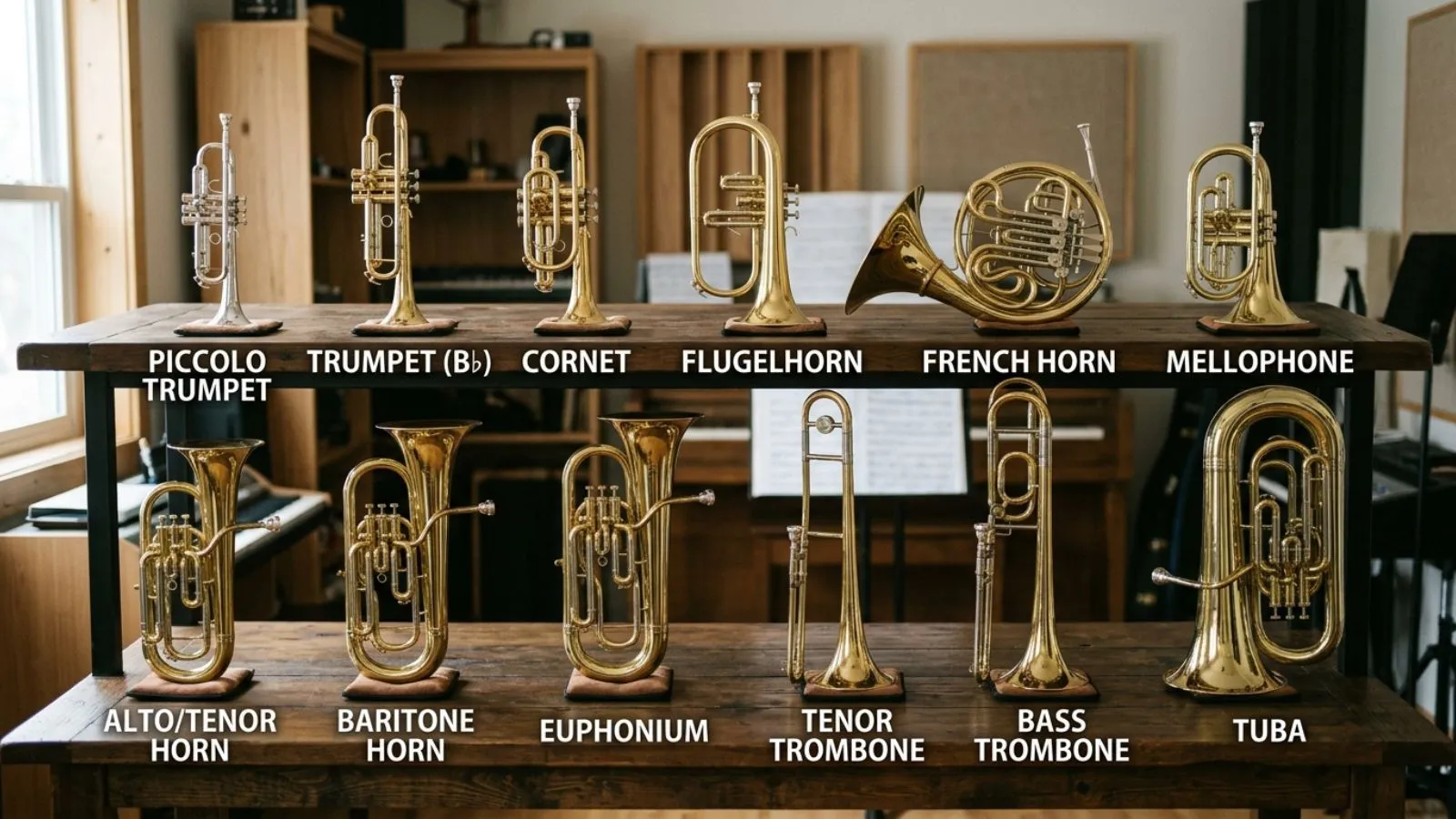
Have you ever watched a marching band or a symphony orchestra and wondered “What are all those shiny instruments called?” You’re not alone!
Brass instruments have been making music for thousands of years and their names can be confusing especially when so many of them look alike.
If you’re a student learning about music, a beginner picking your first instrument or simply a curious soul who loves the sound of a good trumpet solo, knowing the names of brass instruments opens up a whole new world.
From the tiny piccolo trumpet to the massive contrabass tuba each instrument has a unique sound story and personality.
In this guide we’ll walk you through all brass instrument names organized into fun and helpful categories.
You’ll learn what makes each one special, what it sounds like and why musicians love it. By the end you’ll be able to name every brass instrument like a pro.
Let’s dive in! 🎺
🎺 Classic Brass Instruments Names (The Legends)
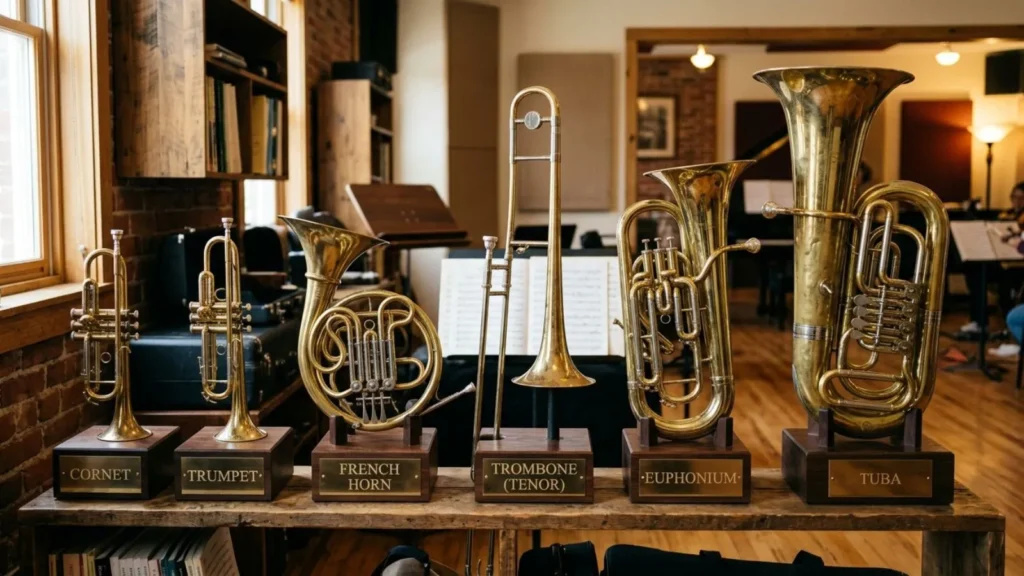
These are the instruments that started it all. Classic brass instruments are the backbone of orchestras, bands and jazz ensembles around the world. If you’ve heard brass music you’ve almost certainly heard these legends in action.
- Trumpet Meaning: From the Old French trompette meaning “little trump.” The trumpet is the most recognizable brass instrument, bright , bold and powerful.
- Trombone Meaning: Italian for “big trumpet.” The trombone uses a sliding tube instead of valves giving it a smooth rich sound.
- French Horn Meaning: Named after France where the modern design was developed. It has a warm mellow tone and a coiled circular shape.
- Tuba Meaning: Latin for “tube” or “trumpet.” The tuba is the largest and lowest-pitched brass instrument in the orchestra.
- Bugle Meaning: From Old French bugle meaning “wild ox horn.” The bugle is one of the oldest brass instruments used in military signals.
- Cornet Meaning: From the Old French cornet meaning “little horn.” It looks like a trumpet but has a mellower rounder sound.
- Euphonium Meaning: From Greek euphonos meaning “well-sounding.” It’s a medium-sized brass instrument with a warm baritone tone.
- Baritone Horn Meaning: From Greek barytonos meaning “deep-sounding.” Similar to the euphonium but with a slightly brighter tone.
- Flugelhorn Meaning: German for “wing horn.” It has a wider darker tone than the trumpet and is popular in jazz music.
- Sousaphone Meaning: Named after composer John Philip Sousa. It’s a large tuba designed to be worn over the shoulder in marching bands.
🎶 Cute Brass Instrument Nicknames (Fun Names Musicians Use)
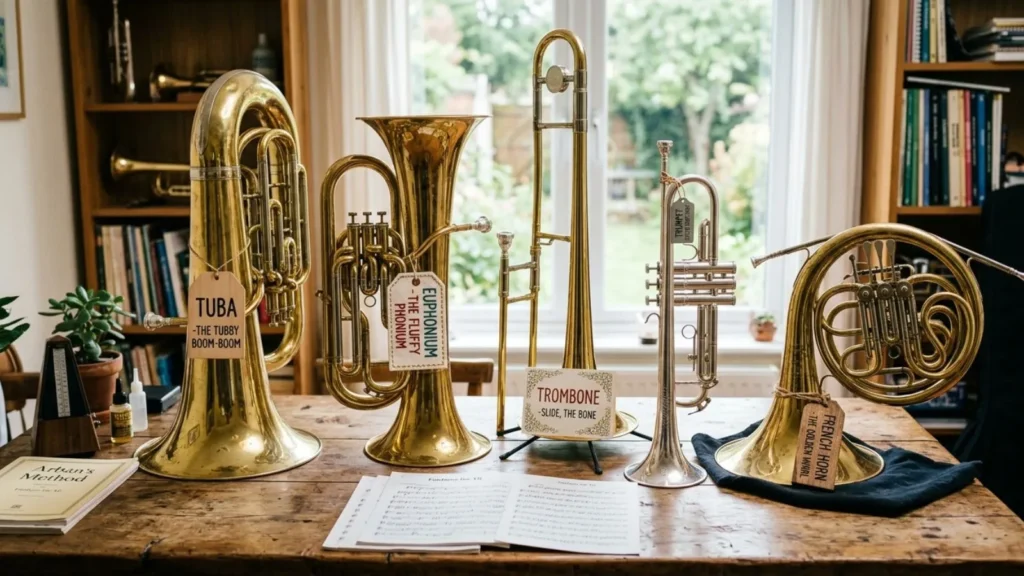
Musicians love giving their instruments playful nicknames. These cute names show just how much players adore their brass companions. You might hear these in rehearsal rooms and band halls everywhere.
- Trumpet → “Trumpy” Meaning: A lovable short form used by young beginners who treat their trumpet like a best friend.
- Tuba → “Big Bertha” Meaning: A fun nickname for the largest brass instrument because it’s big, bold and impossible to ignore.
- French Horn → “The Pretzel” Meaning: Named for its twisted pretzel-like coiled shape that confuses beginners and delights everyone else.
- Trombone → “The Slide” Meaning: A no-nonsense nickname that refers to the trombone’s iconic sliding mechanism.
- Euphonium → “Euphi” Meaning: A sweet short nickname for a sweet-sounding instrument easy to say and easy to love.
- Flugelhorn → “Flugel” Meaning: Players often shorten the name because “flugelhorn” is quite a mouthful to say mid-rehearsal!
- Sousaphone → “Sousa” Meaning: A respectful nod to John Philip Sousa the March King who inspired this big bold instrument.
- Cornet → “Little Trumpet” Meaning: New students often call it this because it looks just like a smaller cuter version of a trumpet.
- Baritone → “Barry” Meaning: Band kids love giving human names to their instruments and “Barry” is a perfect fit for the baritone.
- Bugle → “The Call” Meaning: Because for centuries the bugle’s job was literally to call soldiers to battle, to meals and to sleep.
😂 Funny Brass Instrument Names (That Will Make You Laugh)
Not everything in music is serious! Some brass instruments have names or nicknames so funny that even professional musicians can’t help but chuckle. These are the ones that bring a smile to every rehearsal.
- Serpent Meaning: Literally named after a snake because of its long winding S-shaped body. Yes it’s a real instrument!
- Ophicleide Meaning: From Greek meaning “keyed serpent.” A 19th-century instrument that sounds as strange as its name suggests.
- Helicon Meaning: Named after Mount Helikon in Greece. It’s a tuba you wear around your body like a hula hoop.
- Mellophone Meaning: Not quite a trumpet, not quite a horn, it’s the “mellow” middle child that can’t quite make up its mind.
- Cimbasso Meaning: Italian for a low brass instrument used in opera. Even opera singers raise an eyebrow at this name.
- Buccina Meaning: An ancient Roman brass instrument that sounds like a sneeze when you say it out loud. Bless you!
- Lituus Meaning: A long thin Roman horn that sounds like it belongs in a Harry Potter spell rather than a concert hall.
- Alphorn Meaning: A giant Swiss horn played on mountain tops. Because why play music in a concert hall when you can play it on an Alp?
- Cornett (not Cornet!) Meaning: A Renaissance instrument spelled with two t’s that confuses EVERYONE even music teachers.
- Posthorn Meaning: Used by postal workers in the 1800s to announce their arrival. The world’s most musical mail carrier!
🌟 Unique Brass Instrument Names (Rare and Unusual)
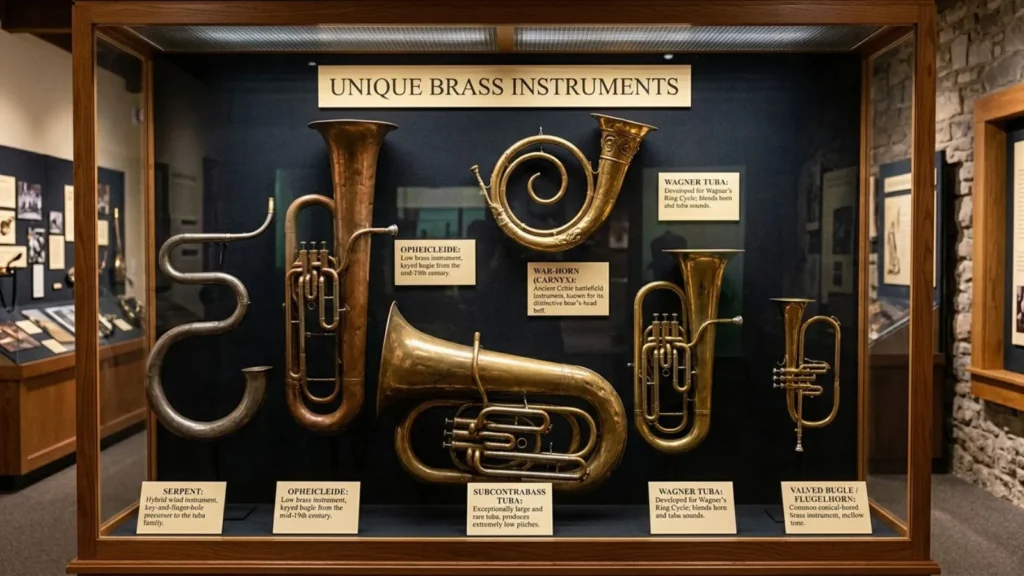
Some brass instruments are so rare that most people have never heard of them. These unique instruments are the hidden gems of the brass world played by specialists and music historians who love digging deep.
- Natural Trumpet Meaning: A trumpet with no valves played purely by lip tension. It’s the original trumpet used in the Baroque era.
- Piccolo Trumpet Meaning: From Italian piccolo meaning “small.” This tiny trumpet plays notes an octave higher than a regular trumpet.
- Bass Trumpet Meaning: A large low-pitched trumpet that fills the gap between the trumpet and trombone in sound.
- Contrabass Trombone Meaning: The lowest trombone in existence so large it requires extra tubing and an incredibly powerful player.
- Alto Trombone Meaning: A smaller higher-pitched trombone that was popular in the Classical era and is making a comeback today.
- Tenor Horn (Alto Horn) Meaning: A British brass band favorite shaped like a small tuba with a soft blending tone.
- Wagner Tuba Meaning: Invented specifically for composer Richard Wagner’s operas. It crosses the sound of a French horn with a tuba.
- Corno da Caccia Meaning: Italian for “hunting horn.” A circular horn used in Baroque music to mimic the sound of the royal hunt.
- Keyed Bugle Meaning: An early 19th-century bugle fitted with keys like a woodwind giving it a wider range of notes.
- Sub-Contrabass Tuba Meaning: The absolute lowest brass instrument ever made so rare and large that only a few exist in the entire world.
🎷 Romantic Brass Instrument Names (Beautiful and Poetic)
Some brass instruments have names that sound like poetry. These are the instruments whose names feel as beautiful as the music they make perfect for anyone who appreciates elegance in sound and language.
- Flugelhorn Meaning: “Wing horn” in German evoking the graceful image of a bird taking flight on a breeze.
- Euphonium Meaning: “Well-sounding” in Greek a name that is itself a compliment, a love letter to a beautiful tone.
- French Horn Meaning: Named after France the country of romance and art a perfect fit for this warm lyrical instrument.
- Corno Meaning: Simply “horn” in Italian is short , elegant and endlessly musical in the way only Italian words can be.
- Lur Meaning: An ancient Scandinavian horn whose name sounds like a gentle whisper carried on the Nordic wind.
- Buccin Meaning: A French Revolutionary-era trombone with a dragon-head bell, dramatic , fierce and undeniably romantic.
- Corno da Caccia Meaning: “Horn of the hunt” a name that paints a vivid picture of misty forests and galloping horses at dawn.
- Harmoniemusik Horn Meaning: From German Harmonie meaning harmony an instrument literally named for the beauty of musical agreement.
- Viennese Horn Meaning: Named after Vienna the city of Beethoven Mozart and Schubert, a name dripping with musical history.
- Alto Flugelhorn Meaning: A rare higher-pitched flugelhorn with an even softer more dreamlike tone than its standard cousin.
🥁 Marching Band Brass Instrument Names (Loud and Proud)
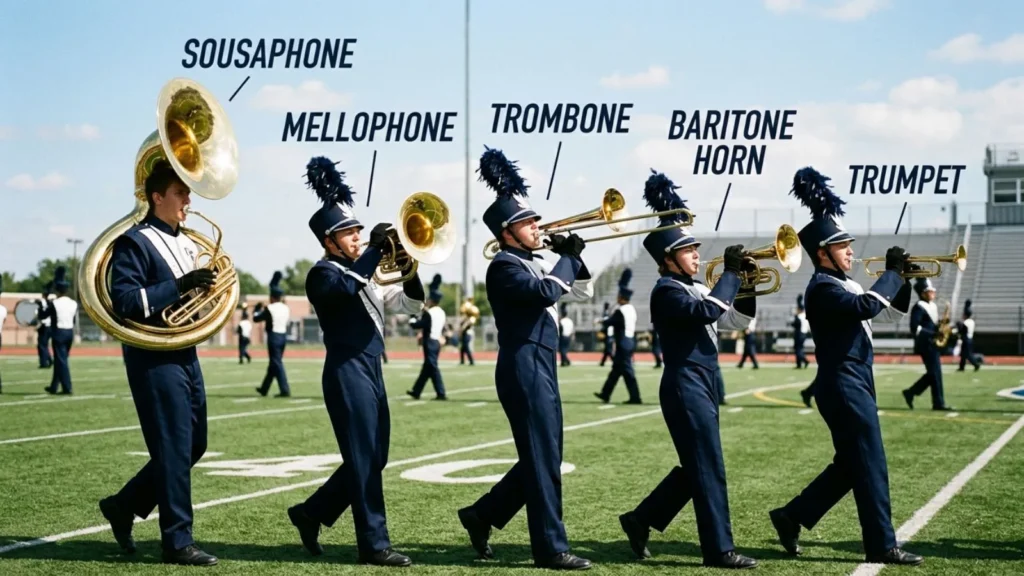
Marching bands need brass instruments that can project sound across a football field. These instruments are built for power, presence and pride. If you’ve been to a halftime show you’ve seen these in action!
- Marching Baritone Meaning: A forward-facing baritone horn designed to project sound outward perfect for outdoor performances.
- Marching Euphonium Meaning: A euphonium modified for marching with a bell that faces forward instead of upward.
- Contrabass Bugle Meaning: The lowest bugle in drum corps producing a deep powerful sound that you feel as much as hear.
- Soprano Bugle Meaning: The highest-pitched bugle leading the melody in drum and bugle corps with a piercing bright tone.
- Mellophone Meaning: A marching-band substitute for the French horn easier to carry and louder outdoors.
- Marching Tuba (Sousaphone) Meaning: The sousaphone is the marching world’s answer to the tuba worn like a giant metallic necklace.
- Drum Corps Trumpet Meaning: A specialized high-powered trumpet used in competitive drum corps for maximum projection and clarity.
- Alto Bugle Meaning: A mid-range bugle pitched between the soprano and contrabass filling the harmonic middle of the corps.
- Flugelhorn (Marching) Meaning: Occasionally used in marching ensembles for a softer blending tone in musical arrangements.
- Tenor Bugle Meaning: A bugle in the tenor range providing the harmonic bridge between alto and baritone voices outdoors.
🎼 Jazz Brass Instrument Names (Cool and Smooth)
Jazz gave brass instruments a whole new life. These are the instruments that define the smoky soulful and swinging world of jazz music. Cool names for cool sounds!
- Trumpet (Jazz) Meaning: The king of jazz brass from Louis Armstrong to Miles Davis the trumpet IS jazz.
- Flugelhorn Meaning: Jazz musicians love the flugelhorn for its dark velvety tone like a trumpet wearing a velvet jacket.
- Cornet Meaning: Early jazz royalty King Oliver and Louis Armstrong both started on the cornet before switching to trumpet.
- Trombone (Jazz) Meaning: The trombone’s gliding slide makes it perfect for jazz “growls” “smears” and expressive blue notes.
- Soprano Trombone Meaning: A tiny rare trombone with a bright sound occasionally used in specialty jazz arrangements.
- Bass Trombone Meaning: The jazz band’s low-end anchor is warm and full of personality in big band arrangements.
- Valve Trombone Meaning: A trombone with valves instead of a slide popular in early jazz and Latin music styles.
- Pocket Trumpet Meaning: A miniature trumpet that packs a full sound into a tiny package beloved by traveling jazz musicians.
- Baritone Horn (Jazz) Meaning: Occasionally used in jazz for its mellow rich tone especially in smaller ensemble settings.
- Alto Horn Meaning: A jazz rarity with a gentle horn-like quality used mostly in novelty or retro jazz arrangements.
🏛️ Ancient and Historical Brass Instrument Names (From the Past)
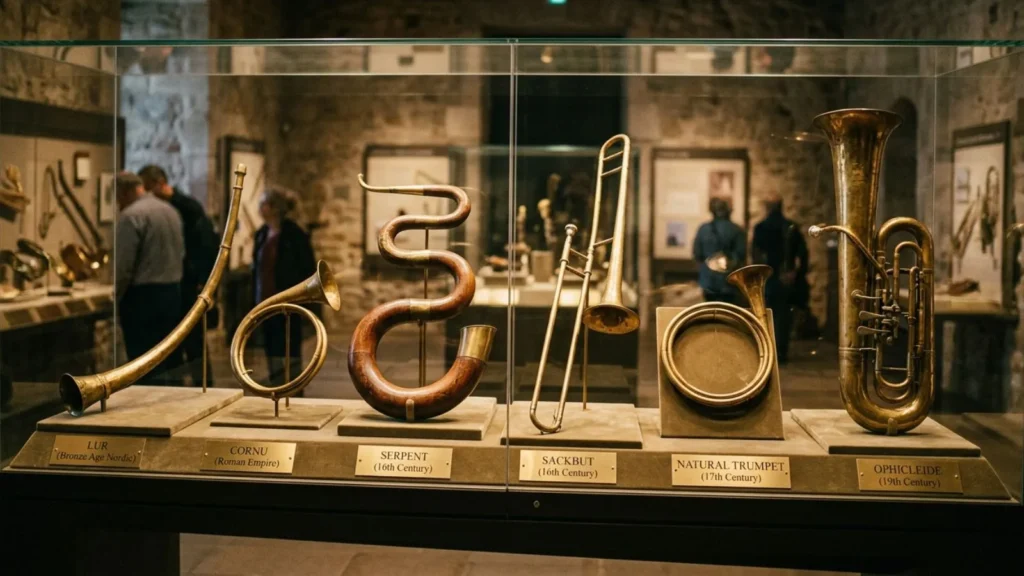
Brass instruments have been around for thousands of years. Long before orchestras and marching bands ancient civilizations were making music with horns and tubes. These historical names connect us to the very roots of music.
- Lituus Meaning: A long thin Roman military horn used to signal troops in battle the trumpet of the ancient world.
- Buccina Meaning: A Roman curved brass instrument used in military ceremonies and public announcements.
- Carnyx Meaning: An Iron Age Celtic war horn shaped like a boar played vertically with an animal-head bell facing the sky.
- Salpinx Meaning: An ancient Greek trumpet used in religious ceremonies and to signal soldiers during warfare.
- Shofar Meaning: Made from a ram’s horn the shofar is one of the oldest wind instruments still used in Jewish religious practice.
- Oliphant Meaning: A medieval ivory horn carved from an elephant tusk used by royalty and knights as a symbol of prestige.
- Didgeridoo Meaning: Though technically a wind instrument from Australia many scholars classify it within the broad brass family.
- Natural Horn Meaning: The predecessor to the French horn a coiled metal tube with no valves played at royal courts and hunts.
- Serpent Meaning: A winding wooden instrument covered in leather used in churches and military bands from the 1590s onward.
- Alphorn Meaning: A traditional Swiss folk horn made from wood up to 12 feet long used to communicate across mountain valleys.
🎵 Orchestral Brass Instrument Names (Symphony Stars)
The orchestra’s brass section is one of the most thrilling sounds in all of music. These instruments sit at the back of the orchestra but always make a massive impression when they play. Here are the stars of the symphony!
- Trumpet (Orchestral) Meaning: The orchestra’s brightest voice used for fanfares, heroic themes and moments of pure musical triumph.
- French Horn (Orchestral) Meaning: The most versatile orchestral brass instrument equally at home in soft mysterious passages and powerful climaxes.
- Tenor Trombone Meaning: The standard orchestral trombone capable of everything from soft chorales to thunderous fortissimo passages.
- Bass Trombone Meaning: The low voice of the trombone section adding depth and power to the orchestra’s brass sound.
- Tuba (Orchestral) Meaning: The foundation of the orchestral brass section providing the bass beneath all the other brass instruments.
- Wagner Tuba Meaning: A rare hybrid instrument written into scores by Wagner and Bruckner for a unique darker horn-like sound.
- Piccolo Trumpet (Orchestral) Meaning: Used in Baroque orchestral music for its ability to reach extremely high clear notes with precision.
- Cornet (Orchestral) Meaning: Occasionally used in French orchestral music (Berlioz Bizet) for a slightly softer alternative to the trumpet.
- Alto Trombone (Orchestral) Meaning: Used in early Classical orchestral music before the tenor trombone became standard in modern orchestras.
- Contrabass Tuba Meaning: An extremely large tuba providing the deepest possible brass sound in large-scale orchestral works.
🌍 World Brass Instrument Names (Global Sounds)
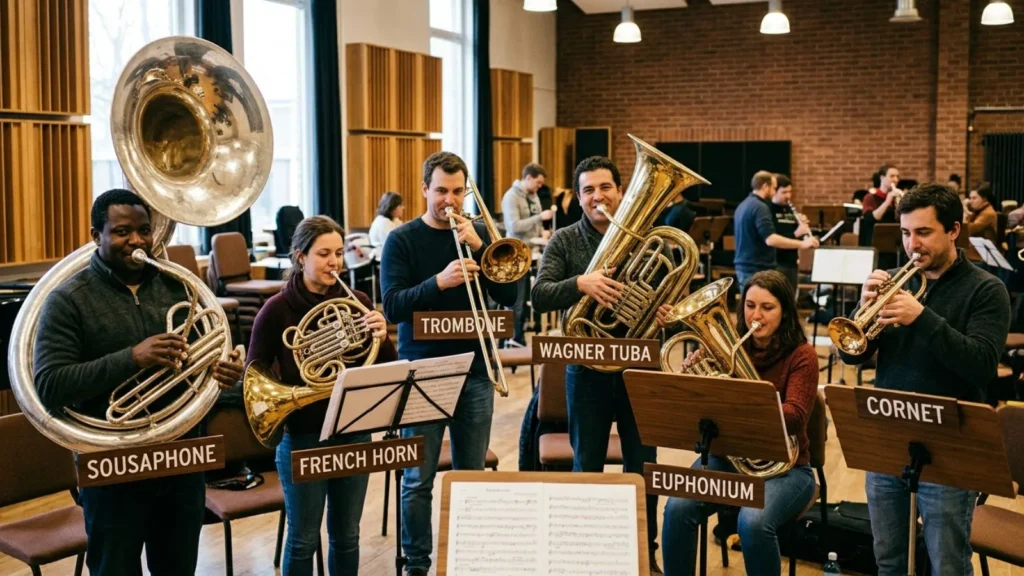
Brass instruments aren’t just European cultures around the world that have developed their own incredible brass and horn traditions. These global instruments prove that the love of brass is truly universal.
- Alphorn (Switzerland) Meaning: A long wooden horn used to call cattle and communicate across Swiss mountain valleys.
- Didgeridoo (Australia) Meaning: An ancient Indigenous Australian instrument made from a hollowed eucalyptus branch one of the world’s oldest.
- Shofar (Israel/Jewish Tradition) Meaning: A ram’s horn blown during Jewish High Holy Days is one of the oldest instruments still in regular use.
- Carnyx (Celtic/Iron Age) Meaning: A tall war horn of the ancient Celts topped with a boar’s head used to intimidate enemies in battle.
- Tutubi (Philippines) Meaning: A traditional Filipino bamboo and metal horn used in folk ceremonies and indigenous music.
- Nafiri (Malaysia/Indonesia) Meaning: A long metal trumpet used in royal Malay court music and ceremonial processions.
- Turaha (New Zealand/Māori) Meaning: A traditional Māori trumpet made from wood or bone used in ceremonial and warrior traditions.
- Bansuri Brass Horn (India) Meaning: A brass horn used in Indian folk and devotional music often played at temples and festivals.
- Kakaki (West Africa) Meaning: A long ceremonial brass trumpet from Nigeria and Niger used by royalty and at important celebrations.
- Dung Chen (Tibet) Meaning: A long Tibetan ceremonial horn used in Buddhist monasteries producing a deep haunting meditative drone.
❓ Frequently Asked Questions (FAQs)
Q1: What are all the main brass instruments?
The main brass instruments are the trumpet trombone French horn tuba cornet euphonium baritone horn flugelhorn and sousaphone.
Q2: What is the highest-pitched brass instrument?
The piccolo trumpet is the highest-pitched brass instrument playing notes an octave above the standard trumpet.
Q3: What is the lowest brass instrument?
The contrabass tuba (or sub-contrabass tuba) is the lowest brass instrument producing extremely deep powerful bass notes.
Q4: What is the most popular brass instrument?
The trumpet is widely considered the most popular brass instrument in the world used in orchestras, jazz marching bands and pop music.
Q5: What brass instruments are in an orchestra?
A standard orchestra includes trumpets, French horns, trombones and a tuba. Some pieces also call for a piccolo trumpet, Wagner tuba or bass trombone.
Q6: What is the difference between a cornet and a trumpet?
A cornet has a more conical bore and produces a mellower rounder sound while the trumpet has a cylindrical bore and a brighter more piercing tone.
Q7: Are saxophones brass instruments?
No. Saxophones are made of brass metal but are classified as woodwind instruments because they use a reed to produce sound.
Q8: What is the oldest brass instrument?
The shofar (ram’s horn) and ancient horns like the carnyx and lituus are among the oldest with some dating back over 3000 years.
✅ Conclusion
What an incredible journey through the world of brass! From the mighty tuba to the tiny piccolo trumpet from the ancient shofar to the high-tech marching euphonium brass instruments come in all shapes, sizes and sounds.
We’ve explored classic legends like the trumpet and trombone, cute nicknames that musicians give their beloved instruments, funny names like the Serpent and the Buccina that make everyone smile and unique rarities that only specialists know about.
We also discovered romantic names full of poetry and beauty, marching band powerhouses built for the outdoors, cool jazz instruments that defined a genre, ancient horns that carried the sounds of history, orchestral stars that fill concert halls with glory and world instruments that prove brass is a truly global language.
Every brass instrument has its own voice, its own story and its own magic. Whether you’re a beginner, a music teacher or simply a curious listener there is a brass instrument out there that will speak directly to your soul.
So go ahead, pick your favorite name from this list, share it with a fellow music lover and let the beautiful world of brass music inspire you every single day. 🎺