Something similar happened to me recently when I came across the term Saddle Parts Names in a conversation with a friend.
At first, I honestly had no idea what it mean i kept reading it again and again, thinking, “Am I supposed to know this already?” It felt a bit awkward because I didn’t want to respond incorrectly or look confused.
Instead of guessing, I decided to pause and actually look into what Saddle Parts Names refers to and why people use these terms.
That small step made a big difference. I discovered that a saddle isn’t just a single piece it has several important components, and each part has its own specific name and function. Once I understood that, everything suddenly made sense.
After learning it properly, I felt much more confident. Now, whenever I see Saddle Parts Names in chats, discussions, or social media posts, I don’t feel lost anymore. Instead, I can follow the conversation easily and even respond with clarity.
It’s a good reminder that even simple-looking terms can have deeper meanings, and taking a moment to learn them can save you from a lot of confusion later.
🏆 The Most Important Saddle Parts Names
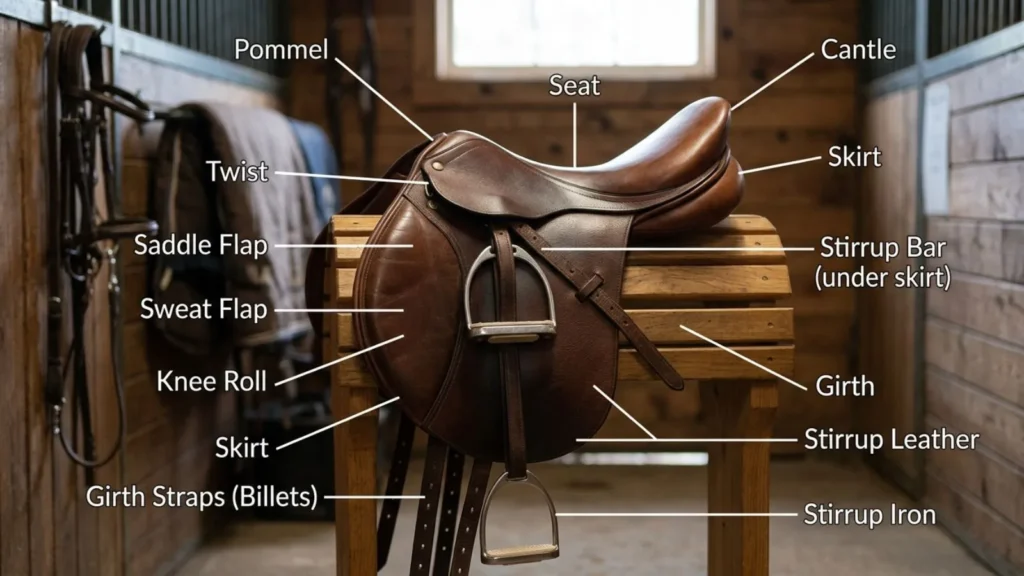
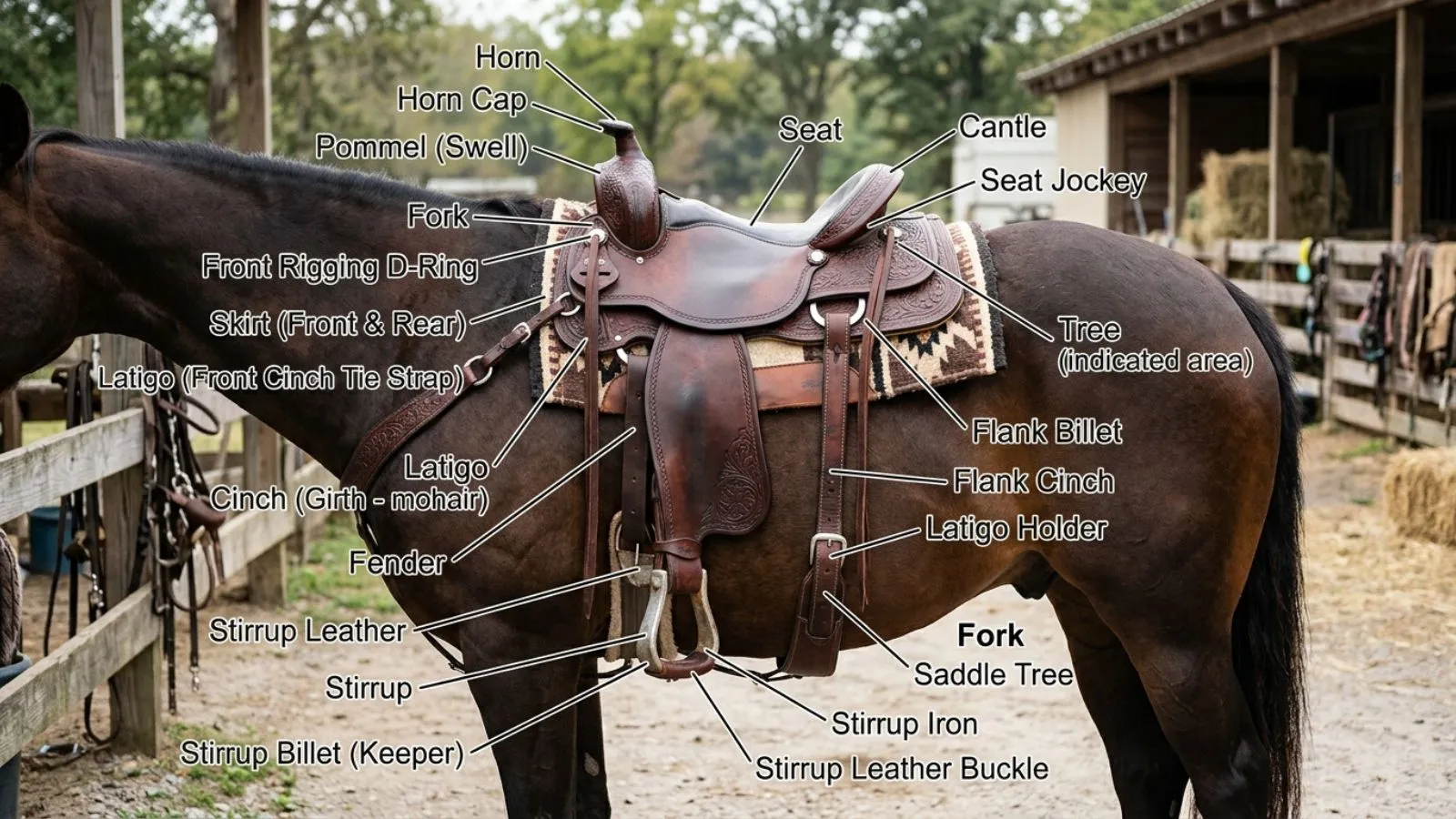
These are the foundational parts of any saddle. Every saddle, English or Western shares these basic components. Knowing them first gives you a strong base to build on.
1. Pommel (Swell) Meaning: The raised front arch of the saddle. In Western saddles it’s called the swell. It keeps the rider from sliding forward and gives the saddle its shape at the front.
2. Cantle Meaning: The raised back part of the saddle seat. It supports the rider’s lower back and prevents sliding backward during rides.
3. Seat Meaning: The central area where the rider sits. It’s designed to be deep or flat depending on the riding discipline.
4. Tree Meaning: The internal frame of the saddle is usually made from wood or fiberglass. The tree determines the saddle’s shape fit and durability.
5. Gullet Meaning: The tunnel-like channel running underneath the saddle from front to back. It sits over the horse’s spine allowing clearance and airflow.
6. Panels Meaning: The padded sections underneath the saddle that rest on the horse’s back. They distribute the rider’s weight evenly.
7. Skirt Meaning: The leather flap that covers the saddle’s bars and tree. It protects the hardware and gives the saddle its outer look.
8. Flap (Saddle Flap) Meaning: The large piece of leather on the side of the saddle. It protects the rider’s leg from the metal stirrup bars and billets.
9. Twist Meaning: The narrowest part of the saddle just below the pommel. It affects how the saddle feels between the rider’s legs.
10. Waist Meaning: The narrow middle section of the saddle seat. It connects the pommel area to the cantle and affects rider comfort and balance.
🔩 Stirrup Parts Names and Everything Below 👇
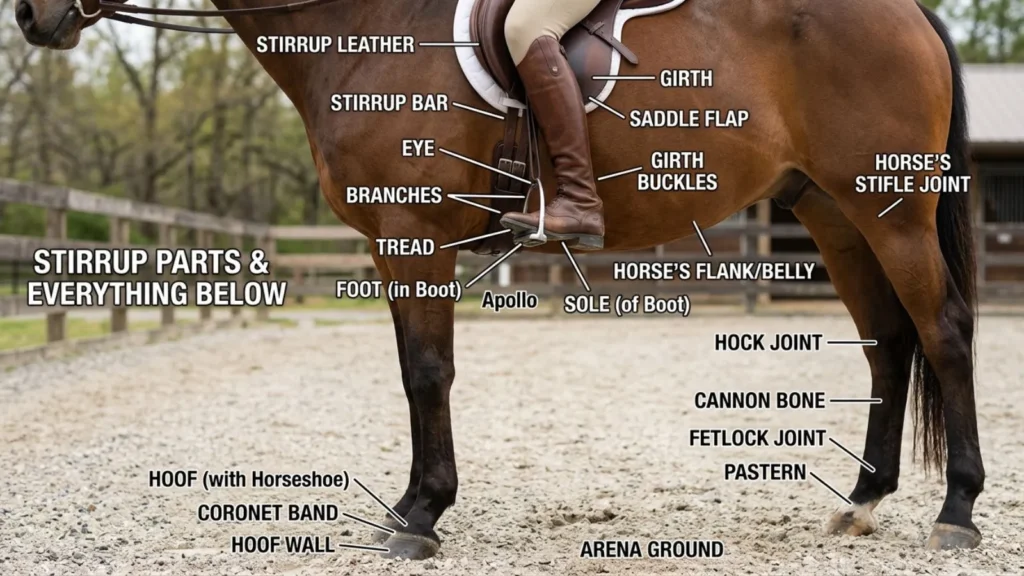
The stirrup system is what keeps your foot secure while riding. These parts work together to give riders stability and control. Getting familiar with stirrup parts names is a must for any rider.
1. Stirrup Iron Meaning: The metal loop where you place your foot while riding. It comes in various shapes and traditional safety offset depending on the discipline.
2. Stirrup Leather Meaning: The strap that connects the stirrup iron to the saddle. It runs through the stirrup bar and is adjustable for different leg lengths.
3. Stirrup Bar Meaning: The metal piece attached to the saddle tree under the flap. The stirrup leather hangs from it. Most bars have a safety release feature.
4. Tread (Stirrup Tread) Meaning: The bottom surface of the stirrup iron where your foot rests. Many treads are rubber-coated for grip and safety.
5. Eye of the Stirrup Meaning: The top loop of the stirrup iron through which the leather passes. It determines how the iron hangs and swings.
6. Branch (Stirrup Branch) Meaning: The side arms of the stirrup iron that form the U-shape. They support the rider’s foot and connect the eye to the tread.
7. Peacock Safety Stirrup Ring Meaning: A rubber ring on a safety stirrup that releases in a fall. It’s especially popular for children and beginner riders.
8. Stirrup Pad Meaning: A removable insert placed inside the stirrup for extra grip or comfort. Common in endurance and trail riding.
9. Fillis Iron Meaning: A classic English stirrup iron with an angled eye. The angle reduces knee and ankle strain during long rides.
10. Offset Stirrup Meaning: A stirrup designed with the eye offset to one side. It helps riders maintain correct alignment and reduces joint pressure.
🧲 Girth and Billet Saddle Parts Names 💪
The girth system holds the saddle firmly in place. Without it the saddle would simply slide off. These parts work as a team to keep everything secure.
1. Girth Meaning: The wide strap that wraps under the horse’s belly. It buckles to the billets on both sides to hold the saddle in place.
2. Billets (Girth Straps) Meaning: Long leather straps hanging beneath the saddle flap. The girth attaches to them. Most saddles have three billets; you use two at a time.
3. Billet Guard (Girth Keeper) Meaning: A small leather tab that covers the billet buckles. It protects the saddle flap from buckle wear and keeps buckles tidy.
4. Point Billet Meaning: The forward-most billet strap. It attaches to the point of the saddle tree for extra stability and prevents the saddle from sliding back.
5. Girth Buckle Meaning: The metal closure on the girth that fastens to the billet holes. They come in smooth or roller styles.
6. Anatomical Girth Meaning: A shaped girth that curves away from the horse’s elbow. It reduces rubbing and gives the horse freer shoulder movement.
7. Stud Billets Meaning: Shorter billets on some close-contact saddles. They use stud-end girths for a slimmer profile under the rider’s leg.
8. Surcingle Meaning: A wide strap that goes over the saddle and girth. It adds security in polo racing and some bareback setups.
9. Girth Sleeve (Girth Cover) Meaning: A soft protective sleeve that slips over the girth. It reduces hair loss and skin irritation in sensitive horses.
10. Cinch (Western Girth) Meaning: The Western equivalent of the English girth. It’s typically made of cord or neoprene and attaches to the latigo strap.
🤠 Western Saddle Parts Names Only 🌵
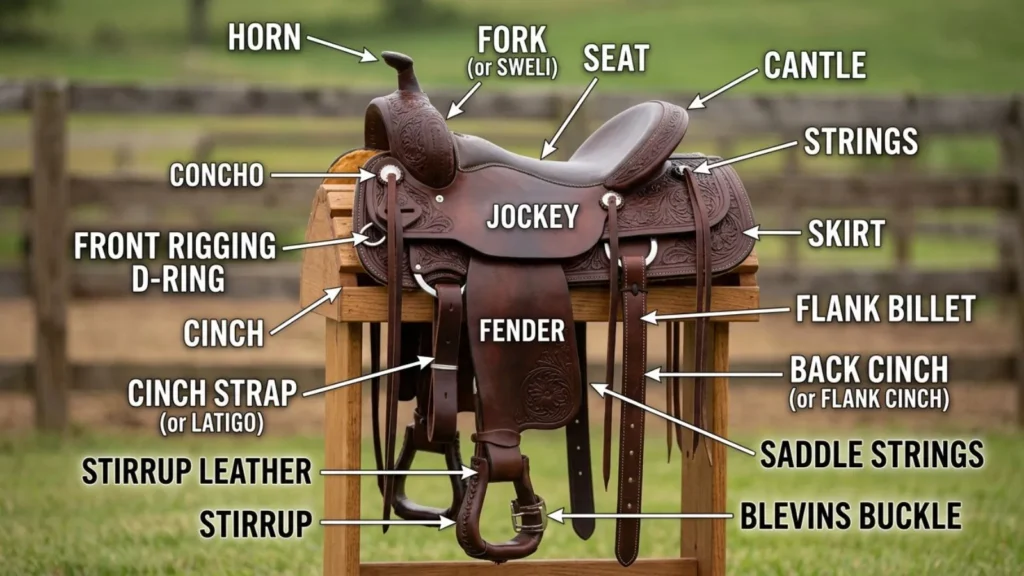
Western saddles have unique parts not found on English saddles. They’re built for ranch work, trail riding and rodeo events. If you ride Western these names are essential.
1. Horn Meaning: The iconic knob at the top front of a Western saddle. Cowboys use it for roping cattle. Recreational riders hold it for balance.
2. Fender Meaning: The wide leather piece that hangs on each side of a Western saddle. It protects the rider’s leg from sweat and the horse’s sides.
3. Jockey Meaning: The small leather piece located just below the seat and behind the horn. It covers the rigging plate and adds saddle structure.
4. Latigo Meaning: A long leather strap on the left side of a Western saddle. It threads through the cinch ring and ties or buckles to secure the cinch.
5. Off Billet Meaning: A shorter strap on the right side of the Western saddle. The cinch buckles directly to it on the non-latigo side.
6. Rigging (Rigging Plate) Meaning: The metal D-ring system on a Western saddle where the cinch attaches. Positioning varies fully 7/8 or 3/4 affecting weight distribution.
7. Seat Jockey Meaning: The piece of leather that makes up the seat area sides of a Western saddle. It sits below the rider’s thigh and above the fender.
8. Rear Cinch (Back Cinch) Meaning: A second cinch used on some Western saddles. It prevents the back of the saddle from lifting during roping.
9. Flank Billet Meaning: The strap that attaches the rear cinch to the saddle. It’s also used with a connector strap linking the front and back cinch.
10. Saddle Strings Meaning: Leather laces threaded through the skirts of a Western saddle. Used to tie on gear like bedrolls, slickers or saddlebags.
🏇 English Saddle Parts Names Only 🇬🇧
English saddles are elegant and close-contact. They’re used for dressage jumping, eventing and hacking. These parts are distinct from English-style riding.
1. Knee Roll Meaning: A padded leather block at the front of the saddle flap. It supports the rider’s knee during jumps and helps maintain leg position.
2. Thigh Roll Meaning: A cushioned block at the back of the saddle flap. It cradles the back of the thigh for added security and position stability.
3. Sweat Flap (Girth Flap) Meaning: A thin inner flap found beneath the main saddle flap. It covers the billets and prevents sweat from the horse’s side soaking through.
4. D-Ring Meaning: A small metal D-shaped ring on the front of the saddle. Riders clip breastplates, martingales or neck straps to it.
5. Pommel Arch Meaning: The curved front of an English saddle. It must have enough clearance to avoid pressing on the horse’s withers.
6. Suede Seat (Suede Insert) Meaning: A rougher textured section in the center of the seat. It gives the rider extra grip and helps maintain position.
7. Wither Pocket Meaning: The space created between the panels and tree that sits over the horse’s withers. Proper clearance here is critical for horse comfort.
8. Cantle Binding Meaning: The raised edging along the back of the seat. It finishes the cantle neatly and adds durability to the seat edges.
9. Panel Gusset Meaning: Extra padding sewn into the panel to customize the saddle fit. Flocking (wool or foam stuffing) fills this space.
10. Stirrup Bar Cap (Safety Catch) Meaning: A small hinged piece on the stirrup bar. When open it allows the stirrup leather to slide off in a fall for rider safety.
🐎 Horse Saddle Fit Parts to Know 📐
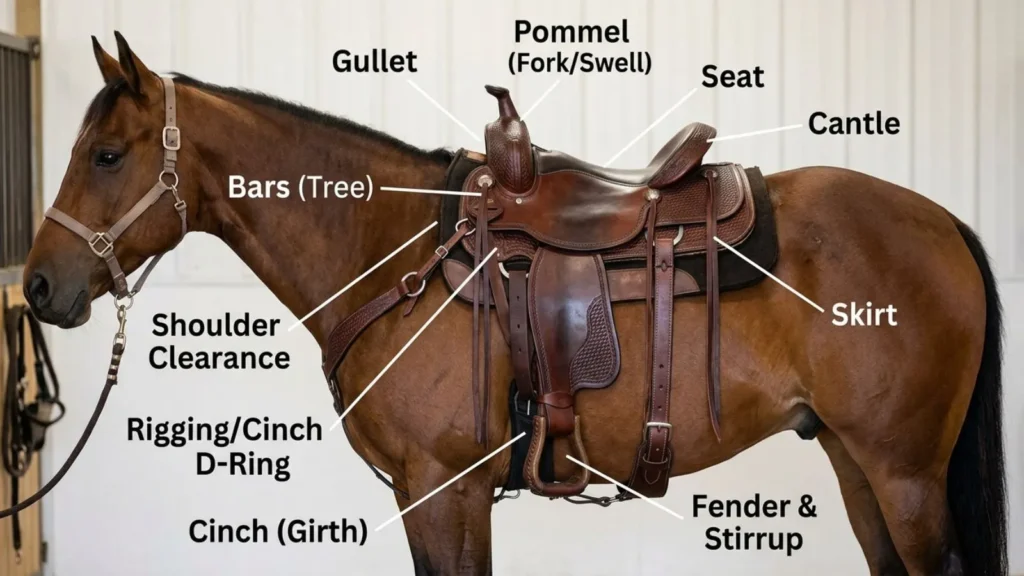
Saddle fit affects your horse’s health and performance. These parts relate directly to how the saddle interacts with the horse’s back. Every horse owner should know them.
1. Wither Clearance Meaning: The space between the saddle gullet and the horse’s withers. Ideally 2–3 fingers of clearance ensures no pressure on this bony area.
2. Channel Width Meaning: The width of the gullet channel along the saddle’s underside. It must be wide enough to avoid pressing on the horse’s spine.
3. Panel Contact Meaning: The area of the panels that touches the horse’s back muscles. Even panel contact is essential for balanced weight distribution.
4. Tree Width Meaning: How wide the saddle tree is across the front. It must match the horse’s shoulder width narrow, medium wide or extra-wide.
5. Point of Tree Meaning: The front tips of the saddle tree that sit behind the horse’s shoulders. Incorrect placement causes shoulder restriction and soreness.
6. Flocking Meaning: The stuffing inside the saddle panels usually wool or foam. It can be adjusted by a saddle fitter to improve fit over time.
7. Bar Angle Meaning: The angle of the Western saddle tree bars. It must match the slope of the horse’s back for even weight distribution.
8. Bridge (Bridging) Meaning: When a saddle only contacts the horse at the front and back panels leaving a gap in the middle. It causes pressure points and soreness.
9. Rocker Meaning: The curvature of the saddle panels from front to back. It should match the curve of the horse’s back for full contact.
10. Balance Point Meaning: The lowest deepest part of the saddle seat. The saddle is balanced when this point sits in the middle not tipping forward or back.
🛡️ Saddle Safety Parts Names 🔐
Safety parts are built into modern saddles for both horse and rider protection. These are often overlooked but incredibly important. Knowing them could save a life.
1. Safety Stirrup Bar Meaning: A bar with a hinged end that releases the stirrup leather when pulled forward hard. Prevents the rider being dragged if they fall.
2. Breakaway Horn (Western) Meaning: A horn designed to release under extreme pressure. Used in team roping to prevent injury if the rope wraps around the horn.
3. Recessed Stirrup Bar Meaning: A stirrup bar that sits flush with the saddle tree. It prevents a lump under the thigh and reduces pressure on the rider’s leg.
4. Velcro Seat Insert Meaning: A removable seat cushion secured by Velcro. Found in treeless saddles and some endurance saddles for comfort adjustment.
5. Anti-Slip Seat Meaning: A textured seat surface that reduces sliding. Often made of suede silicone or roughened leather.
6. Breast Collar Ring Meaning: A D-ring at the front of the saddle where a breastplate attaches. It prevents the saddle from sliding back on steep terrain.
7. Crupper Ring Meaning: A ring at the back of the saddle where a crupper strap attaches. The crupper loops under the horse’s tail to stop the saddle sliding forward.
8. Handle (Grab Strap) Meaning: A leather loop at the front of the saddle. Beginner riders hold it for balance. Also used on trail and endurance saddles.
9. Weight-Bearing Surface Meaning: The total area of the panels that contacts the horse’s back. A larger surface means less pressure per square inch better for the horse.
10. Channel Clearance Meaning: The vertical space between the gullet channel and the horse’s spine. A minimum of one finger’s width is needed to protect the spinal ligaments.
🎨 Saddle Decoration Parts Names ✨
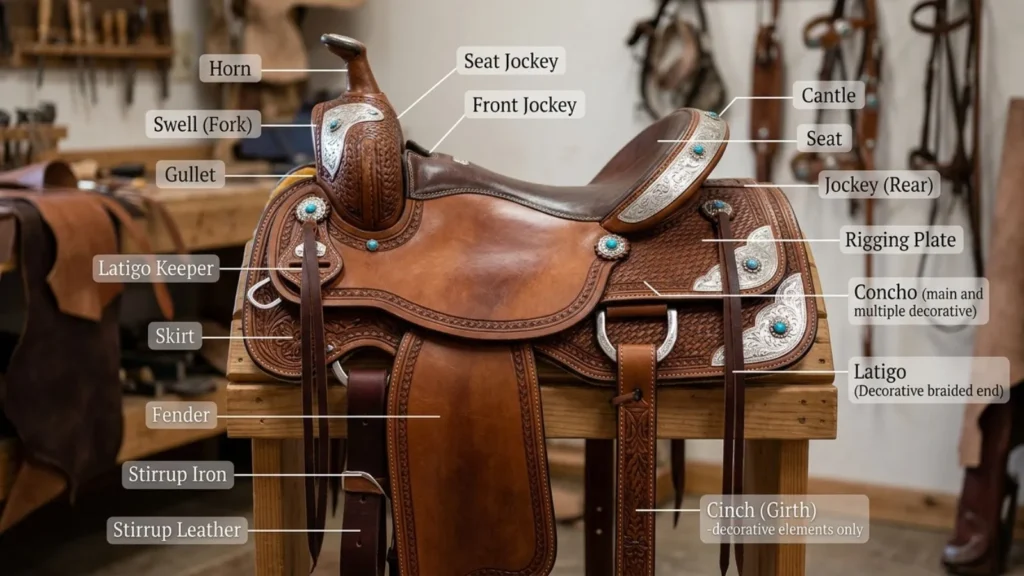
Saddles aren’t just functional, they’re works of art. Decorative parts add beauty and personality to both Western and English saddles. These names come up often in tack shop conversations.
1. Tooling Meaning: Hand-carved floral or geometric patterns stamped into the leather. It’s a traditional Western art form that adds stunning visual detail.
2. Concho Meaning: A decorative metal disc often found on Western saddles and headstalls. They come in silver brass or engraved designs.
3. Silver Trim Meaning: Metal accents added along the saddle skirt edges cantle or horn. Show Western saddles often feature heavy silver trim.
4. Seat Jockey Fringe Meaning: Leather strips hanging from the saddle skirt edges. Common in show saddles and parade saddles for decorative flair.
5. Binding Meaning: The edging sewn or glued around the seat and flap edges. It reinforces and finishes the leather edges cleanly.
6. Lace Trim Meaning: Intricate leather lacing along saddle borders. It’s both decorative and functional reinforcing stitched seams.
7. Inlay Leather Meaning: A contrasting color or texture of leather set into the saddle design. Creates visual interest and a custom look.
8. Horn Wrap Meaning: A protective covering placed over the Western saddle horn. Made from rubber leather or neoprene. Also called a horn knot.
9. Saddle Bag Rings Meaning: Small rings sewn or riveted into the back of the saddle skirt. Used to attach saddlebags and trail gear.
10. Stitching Detail Meaning: Decorative thread patterns sewn across the seat flap and skirt. Contrasting thread colors add elegance and a custom appearance.
🔧 Saddle Maintenance Parts Names 🧴
Knowing these parts helps you care for your saddle properly. Regular maintenance keeps leather soft safe and long-lasting. These terms come up when cleaning, conditioning or repairing a saddle.
1. Leather Keeper Meaning: A small loop that holds strap ends in place. Found on stirrup leathers, girth straps and billets to prevent loose ends flapping.
2. Rivet Meaning: A metal fastener used to permanently join two pieces of leather. Common at stress points like billet attachment and D-ring areas.
3. Saddle Stitch Meaning: A hand-stitching technique using two needles and one thread. It’s the strongest and most durable way to sew leather saddle parts.
4. Dee Ring (D-Ring) Meaning: A metal D-shaped ring sewn into the saddle. Used for attaching accessories. Also a stress indicator loose D-rings need repair.
5. Pip (Tongue) Meaning: The metal pin on a buckle that fits through a hole in a strap. If worn it won’t hold properly and needs replacing.
6. Sweat Stain Meaning: Salt deposits left on the leather from horse sweat. Regular cleaning and conditioning remove and prevent this buildup.
7. Stuffing (Flocking Wool) Meaning: The filling inside saddle panels. Over time it compresses and needs topping up or replacing by a qualified saddle fitter.
8. Tree Crack Meaning: A fracture in the saddle tree is a serious problem that makes the saddle unsafe. Detected by squeezing the pommel and cantle together.
9. Panel Seam Meaning: The stitched edge where the panel leather meets the saddle body. Split seams are a common repair need in older saddles.
10. Saddle Soap Meaning: A specialized cleaner for leather saddles. It removes dirt and light grime without stripping the leather’s natural oils.
📚 Quick-Reference Saddle Parts Names Glossary
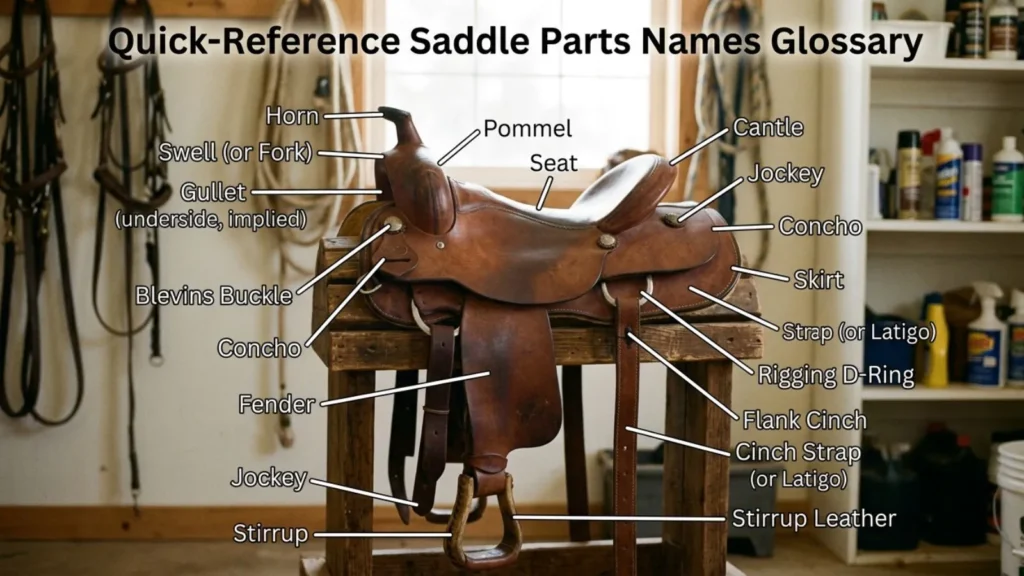
Here’s a fast cheat sheet of commonly confused saddle terms. Perfect for beginners or anyone who needs a quick refresher on saddle parts names.
1. Pommel vs. Cantle Meaning: Pommel = front raised part. Cantle = back raised part. Easy trick: C = cantle = comes after (back).
2. Tree vs. Frame Meaning: In saddles “tree” is the correct term for the internal frame. “Frame” is not standard saddle terminology.
3. Flap vs. Fender Meaning: Flap = English saddle side leather. Fender = Western saddle side leather. Different names, same basic function.
4. Girth vs. Cinch Meaning: Girth = English term for the belly strap. Cinch = Western term. Both do the same job.
5. Billets vs. Latigo Meaning: Billets = English saddle straps. Latigo = Western long tying strap. Both attach the girth or cinch.
6. Knee Roll vs. Thigh Roll Meaning: Knee roll = front pad supporting the knee. Thigh roll = rear pad supporting the back of the thigh.
7. Channel vs. Gullet Meaning: These terms are often used interchangeably. Technically the gullet is the tunnel opening; the channel is the full-length groove.
8. Panel vs. Cushion Meaning: Panel is the correct saddle term. “Cushion” is informal. Panels are structural leather pieces with stuffing inside.
9. Swell vs. Fork Meaning: Both refer to the Western saddle’s front. Fork is the wooden tree part; swell is the leather-covered visible front.
10. Seat vs. Chair Seat Meaning: Seat = the riding surface. Chair seat = a deep reclined seat position. Chair seats limit effective riding position.
❓ Frequently Asked Questions (FAQs)
Q1: What are the main parts of a saddle?
The main parts are the pommel cantle seat tree gullet panels, flap skirt stirrup leathers and stirrup irons. These form the core structure of any saddle.
Q2: What is the tree of a saddle?
The tree is the internal frame of the saddle. It’s usually made from wood fiberglass or polymer. The tree determines the saddle’s shape and fits on the horse’s back.
Q3: What is the difference between a gullet and a channel?
The gullet is the front opening under the pommel. The channel is the full-length groove running under the saddle over the horse’s spine. Both terms are sometimes used interchangeably.
Q4: What are billets on a saddle?
Billets are the leather straps that hang beneath the saddle flap. The girth buckles onto them to hold the saddle in place on the horse.
Q5: What is a saddle tree width?
Tree width refers to how wide the front arch of the saddle is. It must match your horse’s shoulder and back width narrow, medium wide or extra-wide for a proper fit.
Q6: What is the horn on a Western saddle for?
The horn is the raised knob at the front of a Western saddle. Cowboys use it for dallying a rope when roping cattle. Recreational riders may hold it for balance on steep terrain.
Q7: What does flocking mean in saddle terms?
Flocking is the stuffing material inside the saddle panels, usually wool. It can be added or removed by a saddle fitter to improve the saddle’s fit on the horse over time.
✅ Conclusion
Understanding saddle parts names is one of the most useful things any rider or horse owner can learn.
From the foundational tree and panels to decorative conchos and tooling every part has a name and a purpose. Knowing these names helps you buy smarter, communicate better and care for your tack with confidence.
We covered core parts like the pommel cantle and seat it explored stirrup components girth and billet systems and the unique parts of both Western and English saddles.
At also looked at saddle fit terminology safety features, decorative details and maintenance vocabulary.
Now that you have this complete guide to saddle parts, pick the sections most relevant to your riding style and bookmark this page.
Share it with fellow riders, new students or anyone who’s ever pointed at a saddle and said “What’s that thing called?” Your saddle knowledge just leveled up! 🐴

Harper Bailey, a professional writer and expert at Nameoura.com. I create clear, engaging, and reader-friendly articles on business